What is the DOPE 4 Bird Personality Test?

birds d.o.p.e. dove owl peacock eagle personality assessment mind behavior dope test

Want a quick way to get a better understanding of your personality? This “DOPE Bird Personality Test” (the dove, owl, peacock, eagle test – a personality test and not a drug-test) is a very useful tool for gaining some quick insight into your inner workings.
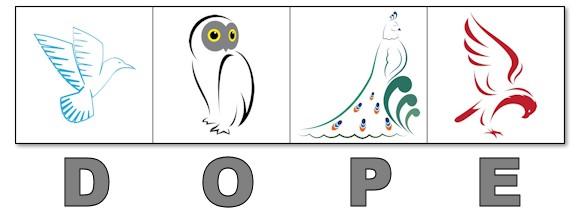
However you use it, the key is to find the positive points of this self-discovery exercise. It’s like having a good friend help you experience your life from the outside. It’s hard to notice that pimple on your nose without someone mentioning something (or a mirror). This test is the mirror.

Know that you are the unique you and you’re loved for that. Use the results of this test as a starting point for your next “self-improvement” step. It is not a judgment and is not a psychological evaluation.


What are the 4 Bird Personality Types?

And here’s the second-to-last moment you’ve been waiting for – quick and simple definitions of what the four bird personality types actually are. Here goes:

DOVE: DOPE Bird Personality Test
DOVE:

The peaceful dove. The dove is people-orientated, loyal, friendly, hard working and a great team player but tends to avoid change, confrontation, risk-taking and assertiveness.

PEACOCK: DOPE Bird Personality Test
PEACOCK:

The showy peacock. The peacock loves talking, being the center of attention, has passion/ enthusiasm and is happy/ optimistic. Peacocks can be accused of talking too much, and aren’t good with detail or time-control.

OWL: DOPE Bird Personality Test
OWL:

The wise owl. The owl is logical, mathematically minded, methodical and sometimes seen as a perfectionist. The owl can be slow to make decisions and inflexible if rules and logic says otherwise. Owls are not big risk takers but love detail.

EAGLE: DOPE Bird Personality Test
EAGLE:

The bold eagle. Eagles are dominant, stimulated by challenge, decisive and direct. Eagles can be blunt/ stubborn, can lose sight of the big-picture and can be insensitive to other people’s needs. Eagles are natural achievers.

Are you already getting a pretty good feel for what bird type you are? How about those around you? That’s another great thing about the test – it helps you start to notice things about people. Until you know what to look for, you might never see it.


Research and History of the DOPE Bird Personality Test

The RichardStep DOPE Test is based off of the original four personality types test theorized by Dr. Gary Couture. He didn’t pick the catchy name for the DOPE test, and with the confusion with illegal substances, I can understand that.

Really looking to be bored to death by the details? Here’s how I designed this test:

analyzed 17,103 test results from the online only version of the DOPE test here on richardstep.com
adaptated research from the B.E.S.T. test (Bold Expressive Sympathetic Technical)
adaptated research from Dr. William Marston’s DiSC test (Dominant, Influencer, Steady, Compliant)
included study and research from personality psychology textbooks
included insights from some of the best in personal development books and research


The DOPE bird personality test is one of those “don’t have to have a psychologist,” fun, and useful tools that I’ve permanently added to my personal development toolbox.

Learn more about your DOPE Personality Test


.

Richard

Richard spent the beginning of the new millennium fighting off cancer. Having questioned all that could be questioned, he realized the good Lord wasn’t ready for him, yet. Richard has made it his life’s goal to guide the growing, mentor the willing, and help those in need... without all the usual self-help fluff.

More Posts - Website - Twitter - Google Plus - YouTube

25 comments to What is the DOPE 4 Bird Personality Test?

  • Betty

    I have been looking for this test for years. I took it when I worked as a CSR for a pharma company over 10 years ago, and it was scarily accurate for all of us in the group, a total of 20 people. Thank you so much for posting!

    • My boss at the last place I worked handed them out and it sure was interesting to see how everyone mixed around. I also had that little voice going off in my head saying, “hey, this is the kind of thing you should keep around for a while!” And I’m glad I did. It provied a great starting point for the research on the RichardStep version. Glad to make something that works just as well for you and hope it helps. :)

  • Thanks for the links! I tried taking the tests. It was fun!

  • Just as I thought I am the Eagle – very fun test thanks !!

  • Psychology-related stuff really interest me. In fact, I plan to study Psychology as my second course most probably next year. This article is very nice. I took the test and I had fun with it. Thanks for the links. You guys better take it now.

    • If I could do it all over again, then I’d at least take a few interesting classes in Psychology… we have so much inside and everyone is so different. So much potential – seems like a great choice! So glad you had fun with the test, too! It may be simple, but it’s a good one. Thanks for the time and comment Maryann!

    • JayHiro

      yeah..psychology is awesome! both learning and teaching..! :D i’m doing it again n again. its fun!

  • JayHiro

    i’m a peacock..! ^_^” its fun..! thanks alot. my friends are owls…most of them. ;)

  • Robyn

    Hey i was wondering how u assess the answers to this dope test because i have to do this test on a friend for a project at my university. we were given the graphs but not quite sure how one assesses it????

  • Scott G

    The more interesting use of this knowledge is to know what is needed from you so you can get what you need from them without frustrating them; i.e. if your boss is an eagle, don’t treat him like an owl. It will be more important to know what your team mates are than to know your own personality type, so ask them to take the test.

    • Absolutely correct and thank you for pointing it out! It might be difficult to convince people to take the test, but it’s worth a shot! And if that doesn’t work, then the assessment sheet gives clues to the verbal and physical cues each bird type gives… you can be your own detective and achieve the same results! Treat people as people first and not labels, of course, but it never hurts to understand a bit more about those you’re around. Thank you for your contribution Scott!

      • Shane B

        This is the true intention of the behavior profile. First understanding yourself. Many of us wont initially agree or are “in the closet” so to speak. For example I’m still the same results today as I was when I first took this test years ago. High on Owl with Peacock right behind it. I didnt want to tell myself I was an Owl and didnt see it. However, the more time goes on the more I catch myself scared to violate rules, be disorginized, etc. Which is funny because the Peacock conflicts with that in some ways. And I see myself battling with decisions because of that internal conflict and now I truly realize why. Second, realizing what you are helps you to adapt and adjust. ALWAYS remember that. The “Golden Rule” goes out the door in this case. We do not “Treat others how we expect them to treat us”. Rather follow the “Platinum Rule” “Treat others how they wish to be treated.” The results are amazing. Last, in team building realizing that placing like behaviors together is not always the answer. For example: A dominant Eagle/Eagle team is not going to be as productive as it may have seemed. Simply because they’re natural acheivers alone doesnt mean it will work the same in groups. They all have attributes that can fill in the voids for where the other is lacking and can offer to keep each other in check. Finding that harmony within your teams will provide amazing outcomes.

        Great Site Richard

        Regards,

        Shane Bergman
        Training & Development

        • Good evening Shane!

          “realizing what you are helps you to adapt and adjust”

          Bingo, sir, bingo! Taking these self assessment tests in a non-placement environment (i.e. – not at a job interview) is so useful. You get to trade the candle you’ve been using to navigate through the dark rooms in life in for a 10,000,000 CandlePower FLOODLIGHT!

          And as far as teams go – I always suspected my wife was my opposite in every way. Well, the MBTI pretty much proved most of that suspicion. But it’s great! Now I know WHY my global thinking, dreamy, sometimes ‘risky’ approach to life isn’t exactly what she sees right off the bat. If I didn’t know her behavioral preferences, then I would have just chalked it up to who knows what with some frustration. Now I can use it as a springboard for growth in our relationship.

          I think the results of these tests (when used the way they are most useful) help us to do one main thing: remove the paralyzing confusion from life and help us default to the “how can I?” mentality instead.

          Thank you for your wonderful comment Shane!

  • nicky

    i cant seem to get the questionaire for this quizz

  • Is there anyway to be a combination of Owl, Eagle, and Dove? I have a little bit of all three. Thanks for the post.

    • I haven’t gotten around to it, yet, but there’s a nice way to show this information in a graph. Divide a sheet of paper into 4 squares. Put one bird in each square. The center point of the paper (where the two axis meet) is 0 for all bird scores. Having a balance closer to 0 for all birds types indicates the most balanced personality profile. The closer to an extreme in any bird type, the greater the impact of the strengths/weaknesses listed for each type.

      Long story short, yes, there are any number of combinations for personality preferences. The results just get a bit more complicated to decipher the more balanced you are. Just look at it this way: if you’re 100% Dove, then consider the results applying to you 100%. If you’re 50% dove & 50% owl, then consider the equal impact of both results on you.

      And, like all personality tests, the results are only as meaningful as you want them to be. Some things apply, some don’t. Make what will work, work.

      Thank you for the comment, Patricia.

    • Shane B

      Patricia,

      I’d like to chime in on this as well. Many confuse this test to result in an all inclusive answer. It is more common to have a result that includes 2 or more of the behavior profiles. Using myself as an example. I’m 30% Owl. This is my dominant behavior at a low 30%. Myself and others definately notice this to be number one. However, as you look at the assessment of each behavior you are going to find traits in each that you agree with and disagree with. The one you most agree with is your dominant behavior. The little traits in that behavior you disagree with are where the other behaviors are filling in the gaps. My secondary behavior is Peacock. I call myself a “closet peacock”. I’m the type that wont call out for attention but if I’m doing something I’m thinking to myself “boy I hope they notice me”. Dove is slightly behind that. I see this coming into play with my approachability and ability to empathize with anyone. Even strangers. And last for me was the Eagle. I have a very long fuse. However when I lose control of a situation and I called upon my owl, peacock, and dove and nothing has worked. The eagle comes out and attempts to control the situation. That’s not always a good thing. Like Richard said the more balanced you are the more difficult it becomes to understand. If you are truly that balanced you may even have some sort of internal struggle in how to handle certain situations from a comfort level. This is where this really comes into play though. It is key that you are able to step out of your comfort zone because you could be dealing with someone that needs that type of communication to recieve it properly. Thats where the “Platinum Rule” comes in. “Treat others how THEY want to be treated”. Not to be confused with the Golden Rule. Now that you have this model in your toolbox of soft skills practice understanding what dominant trait others are to better approach them the way THEY want to be approached. The key is what you say (words), how you say it (tone), and what you’re doing when you say it(body language). You will find this results in better outcomes and builds relationships at work and in life.

      I hope this helps…

      Thanks,

      Shane

Leave a Reply


You can use these HTML tags

<a href="" title=""> <abbr title=""> <acronym title=""> <b> <blockquote cite=""> <cite> <code> <del datetime=""> <em> <i> <q cite=""> <strike> <strong>